Betting Advertising in Brazil: Who Is Liable After Ordinance 73/2026

Until recently, anyone working in betting marketing in Brazil operated under a fairly simple logic: regulatory liability was, in practice, the operator's problem. Agencies, influencers, affiliates, and media outlets ran campaigns, collected their commission, and moved on. Two ordinances published on July 10, 2026 changed that logic for good — and much of the advertising market still hasn't grasped the scale of the shift.
This article explains exactly what changed, why the sector's terminology is as strange as it sounds, whether these rules are already being enforced in practice or are still just theory, and what anyone — individual or company — involved in the betting advertising chain (not just the bookmakers) needs to check before accepting or running a campaign.
The odd name behind sports betting: "lottery-type activity"
A curiosity that helps explain the whole regulatory architecture: why does Brazilian law classify fixed-odds sports betting — which has nothing to do with a drawing — as a "modalidade lotérica" (lottery-type activity)?
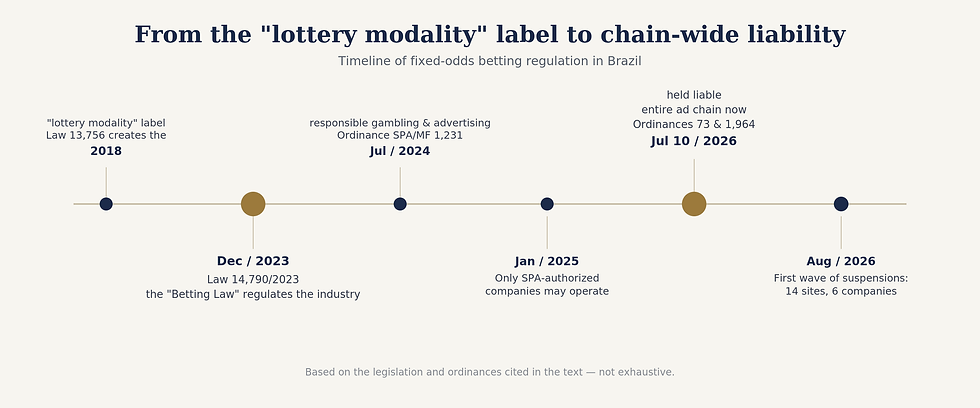
The answer lies in the Constitution, not a drafting accident. Article 22, item XX, of the Federal Constitution gives the Union exclusive authority to legislate on "consortium and lottery systems," a category that has historically covered lotteries and bingo. When lawmakers created fixed-odds betting — first through Law No. 13,756/2018, then fully structured by Law No. 14,790/2023, known as the "Bets Law" — they classified the activity as a lottery type specifically to anchor it within this pre-existing constitutional authority.
That choice had two important practical effects. First, it removed the activity from the field of "games of chance," which have been criminalized under the Criminal Misdemeanors Law since 1941 — lotteries have always been treated as a legitimate exception to that general prohibition. Second, it ensured that only the federal Union could legislate on the subject, avoiding a patchwork of conflicting state rules. It's worth noting this doesn't entirely foreclose territorial disputes — Brazil's Supreme Court has already ruled that the Union's exclusivity over operating lotteries was not received by the 1988 Constitution, which opened the door to state-run lotteries — but the authority to legislate on the system itself remains exclusively federal.
That's why, despite the name, Law 14,790/2023 itself makes clear, in the sole paragraph of Article 1, that it does not apply to traditional lotteries, which remain governed by their own legislation. "Lottery-type activity" is a label of constitutional authority, not a functional equivalence.
Two ordinances, one goal: July 2026 redesigned betting advertising in Brazil
On July 10, 2026, the federal government published, in the same edition of the Official Gazette, two rules that work together:
SPA/MF Ordinance No. 1,964/2026 — amends SPA/MF Ordinance No. 1,231/2024 and details the mandatory warnings that every betting advertisement must display, with standardized language about the risks of gambling addiction. This specific warning requirement took effect on July 17, 2026, seven days after publication.
Interministerial Ordinance MF/SECOM/MJSP No. 73/2026 — jointly issued by the Ministry of Finance, the Presidency's Secretariat of Social Communication, and the Ministry of Justice and Public Security, this is the more structural of the two rules. It establishes the entire consumer-protection framework for betting advertising and organizes cooperation among three enforcement bodies: the Secretariat of Prizes and Betting (SPA), the National Consumer Secretariat (Senacon), and the National Secretariat for Digital Rights. Unlike the warnings ordinance, this one took effect immediately on its publication date, with no adaptation period.
Together, these two rules prohibit practices that were common in the sector's campaigns until recently: linking betting to investment or income generation, promising easy winnings or financial success, showcasing winning bets as a promotional tool, or using content that encourages compulsive betting. They also now require every advertisement to clearly identify the advertising operator and its SPA authorization number.
The game-changer: liability is no longer just the operator's
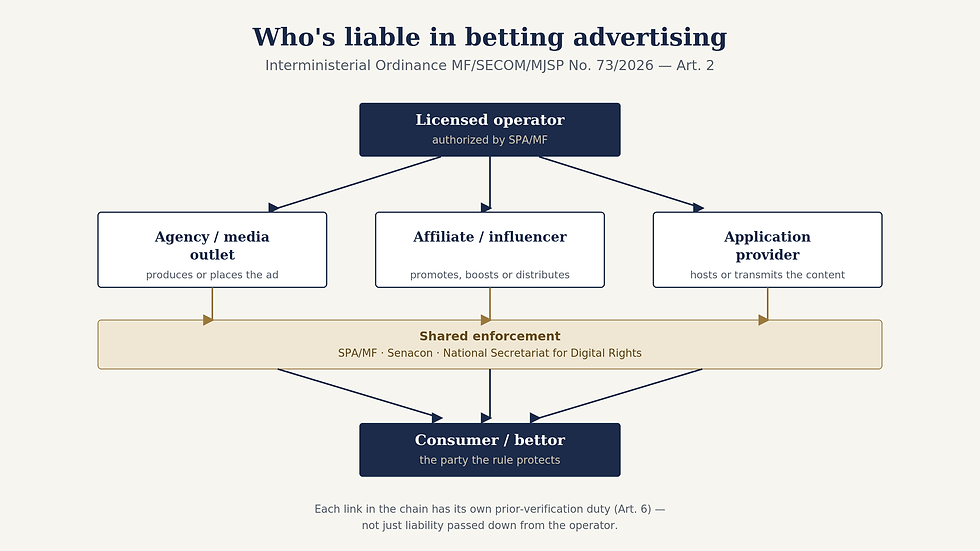
Here is the change fewest people have discussed, and the one most relevant to anyone working in digital marketing, programmatic media, or affiliate partnerships: Article 2 of Ordinance 73/2026 deliberately defines its scope broadly. The rule applies not only to betting operators, but to "individuals or legal entities that produce, promote, sponsor, disclose, transmit, distribute, boost, or run" advertising related to fixed-odds betting — through any means, format, or channel, direct or indirect, on their own behalf or through third parties.
In practice, that includes advertising agencies, media outlets, internet application providers, performance-marketing affiliates, and digital influencers. All of them now carry their own obligations, rather than a liability merely "borrowed" from the operator that commissioned the campaign.
Article 6 of the ordinance is the most operational provision in this regard: before running any ad, anyone in the advertising chain has a duty to verify, as a condition of taking on the engagement itself, whether the advertiser is an authorized operator listed in the official registry maintained by the SPA. That verification must include, at minimum, the advertiser's name or corporate name and tax ID (CNPJ), plus its authorization number. This information must be displayed clearly and accessibly on the interface where the ad runs — checking once and forgetting about it isn't enough; it's an ongoing transparency obligation.
There's also a second standard that's harder to operationalize in practice: the prohibition on advertising that could "reasonably be expected" to reach minors. This standard is especially challenging for anyone buying media programmatically — that is, through ad networks that distribute campaigns automatically, via real-time auction, across a pool of sites matching certain targeting criteria. In that model, the media buyer frequently doesn't choose, and can't even see, exactly which domains the ad will appear on — which makes the audience-verification duty structurally more complex than in a direct, negotiated media partnership with specific publishers.
Is this already being enforced, or is it still just theory?
It's worth separating what the rule authorizes on paper from what has actually been enforced so far — because the difference matters quite a bit when calibrating real risk.
Brazil's betting-enforcement apparatus has already shown it won't hesitate to act. In August 2026, the SPA preemptively suspended 14 betting sites linked to six companies, mainly over failures related to the documentation and information required for oversight. The practical consequences were substantial: an immediate ban on accepting new bets, cancellation of pending bets, mandatory refunds to users, and a daily fine of R$200,000 for noncompliance with the measure. According to the Ministry of Finance itself, between May 2025 and May 2026, 39 administrative sanction proceedings had already been concluded, with sanctions ranging from warnings to fines to suspensions — with another 40 proceedings still underway.
The fine ranges set out in Law 14,790/2023 are substantial: from 0.1% to 20% of gross betting revenue (GGR), potentially reaching R$2 billion in extreme cases, in addition to domain blocking, payment-method blocking, and license revocation.
As for the advertising chain specifically — affiliates, influencers, and agencies — the picture is more recent and still taking shape. There has already been concrete action against content and profiles linked to promoting unauthorized operators, with tens of thousands of sites and roughly a thousand influencer profiles taken down. What hasn't yet publicly materialized is a track record of sanctions applied to affiliates or influencers specifically for advertising-compliance failures while promoting already-licensed operators. That shouldn't be read as a sign that the risk is low — the rule dates from July 2026, the enforcement apparatus is actively expanding, and regulatory coverage during major sporting events has been treated as a priority — but it is a real distinction between normative exposure and enforcement track record, one that any honest risk analysis needs to account for.
But does an ordinance really carry the same force as a law?
A point of administrative law that tends to cause confusion, including among marketing professionals: an interministerial ordinance does not have the force of law, and it's certainly not equivalent to a provisional measure.
A Provisional Measure (Medida Provisória) is issued by the President of the Republic, takes immediate effect as law, and must be converted into law by Congress within a constitutional deadline, or it lapses. It is a primary form of legislation, expressly provided for in Article 62 of the Constitution.
An ordinance (portaria), on the other hand, is a sub-legal administrative act, issued by government ministers under the regulatory power set out in Article 87, sole paragraph, of the Constitution — whose function is precisely to "issue instructions for the execution of laws." In other words: it regulates and operationalizes obligations that already stem from an existing law (in this case, mainly Law 14,790/2023 and the Consumer Protection Code), but it cannot, in principle, create substantively new obligations without a legal basis. That's a relevant distinction even from a defense standpoint: if a specific provision of an ordinance is interpreted in a way that goes beyond what the law already provided for, it could, in principle, be challenged as a violation of the legality principle.
That doesn't make the ordinance harmless — it has immediate effect, a real enforcement mechanism, and concrete sanctions behind it, as shown above. But it is a technical distinction that matters for anyone assessing defense or compliance strategy.
Practical checklist: what to verify before accepting or running a betting campaign
For anyone in the betting advertising chain — whether an agency, media outlet, affiliate, or influencer — a few points deserve systematic verification, not just on the first campaign, but on an ongoing basis:
Confirm the operator's authorization directly in the SPA's official registry, rather than simply relying on the advertiser's word or a sales contact's assurance.
Keep the operator's tax ID (CNPJ) and authorization number on file, and display them accessibly alongside the ad that runs.
Review the creative content against prohibited practices: linking betting to investment or income, promising easy winnings, showcasing winning bets as proof of success, or any appeal that could be read as targeting minors.
Include the mandatory warning about addiction risk on every advertisement, using one of the required standardized phrases.
Document in writing any approval received from the operator, and confirm it came through the communication channel formally designated in the contract — informal approvals through unofficial channels may not bind the operator contractually, and they certainly won't bind the enforcement authorities.
Critically evaluate media-buying formats that limit visibility into where the ad will actually run, such as programmatic ad networks — and, where possible, document in writing the audience-exclusion criteria used.
Frequently asked questions
Does Ordinance 73/2026 apply only to advertising for illegal betting operators, or also to promoting already-licensed ones?
It applies to both. The rule doesn't distinguish based on whether the advertised operator is in good standing — the duty of prior verification and the other obligations apply to all fixed-odds betting advertising, including when the operator is duly authorized by the SPA.
Can an affiliate or influencer be held liable even without having created the advertising content, only distributed or boosted it?
Yes. Article 2 of the ordinance expressly includes anyone who "distributes, boosts, or runs" the advertising, in addition to whoever produces it — liability isn't limited to content creation.
Does an informal approval from a sales contact at the operator protect the affiliate in the event of an enforcement action?
Not necessarily, and for two distinct reasons. Contractually, many affiliate agreements require that communications from the operator come through a formally designated channel to be considered binding — an approval by personal or informal email may not even be valid between the parties. From a regulatory standpoint, even a fully valid approval from the operator doesn't bind public enforcement authorities, which apply the rule independently of the private contractual relationship between operator and affiliate.
Are companies or affiliates based outside Brazil also subject to these rules?
The ordinance doesn't condition its application on having a registered office or address in Brazil — the test is whether advertising for fixed-odds betting reaches the Brazilian public, directly or indirectly. Lacking a Brazilian tax ID or domicile may make practical enforcement of a given sanction harder, but it doesn't, by itself, rule out the rule's applicability or the enforcement authorities' jurisdiction.
Can an ordinance really impose obligations on someone with no direct connection to the Brazilian government?
From the standpoint of the hierarchy of legal norms, the ordinance regulates obligations that stem from Law 14,790/2023 and the Consumer Protection Code — laws that, by their consumer-protection nature, apply based on the effect produced within Brazilian territory, not the nationality or domicile of whoever performs the act. This is a genuine legal question, especially in international advertising chains, and one that should be assessed on a case-by-case basis.
This article is for informational purposes only and does not replace a legal analysis of any specific situation. If you operate, run, or broker advertising related to fixed-odds betting in Brazil, a compliance assessment tailored to your business model is the safest path before moving forward with a campaign.
Comments